Market Reports · February 25, 2026
The $12 Billion Migration: Why Billionaires Are Choosing Miami
Mark Zuckerberg and Priscilla Chan are in contract for a $150M+ estate on Indian Creek Island — joining Jeff Bezos, Tom Brady, and Ivanka Trump. But for serious investors, this isn't about celebrity neighbors. It's about strategy.
By Condo Invest Miami Research · Editorial & market research · 7 min read
Billionaires Aren't Just Buying Homes. They're Repositioning Capital.
The Wall Street Journal reports Mark Zuckerberg and Priscilla Chan are under contract for a $150M–$200M estate at 2 Indian Creek Island Road in Miami — a newly completed waterfront mansion developed by Jersey Mike's founder Peter Cancro. The deal moved quietly off-market, avoided a public listing, and threatens to set a new Miami-Dade County residential record.
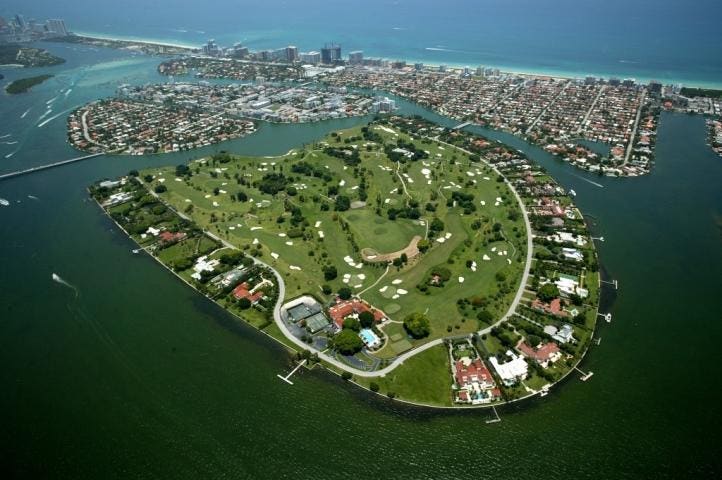
Zuckerberg now sits beside residents like Jeff Bezos, Tom Brady, and Ivanka Trump on the so-called "Billionaire Bunker" — a 300-acre private island with its own police force, 30 homes, and zero public access.
Celebrity neighbors make headlines. For sophisticated investors, this is about reallocating capital at scale.
The Catalyst: California's Proposed $12 Billion Tax
California's proposed 2026 Billionaire Tax Act would levy a one-time 5% tax on the global net worth of individuals who were California residents as of January 1, 2026, and whose net worth exceeds $1 billion.
For someone like Zuckerberg, with an estimated net worth above $200 billion, that liability could represent an estimated $12 billion. For Larry Page or Sergey Brin, the numbers are similarly staggering.
Markets reacted fast. Miami luxury brokers report some ultra-wealthy buyers established Florida residency and closed on properties within seven days after the tax gained traction.
This migration is measurable. It is already happening:
Buyer · Property · Price
--- · --- · ---
Mark Zuckerberg · Indian Creek Island (2 Indian Creek Island Rd) · $150M–$200M
Jeff Bezos · Indian Creek Island · Undisclosed
Larry Page · Two Coconut Grove estates · $173.4M
Sergey Brin · Allison Island waterfront mansion · $50M
What Is Indian Creek Island?
Indian Creek Island — officially Indian Creek Village — is a 300-acre private municipality in Miami-Dade County, separated from Miami Beach by Indian Creek waterway. It offers:
- 30 single-family homes across the entire island
- Its own police force — a dedicated security detail that patrols the island 24/7
- A private golf course — the Indian Creek Country Club, one of the most exclusive in Florida
- No public access — the single bridge is guarded at all times
- Its own municipal government — Indian Creek Village is an incorporated municipality with its own mayor and council
This is not a gated community. It functions as a sovereign enclave inside Miami-Dade County.
The Miami Edge: Three Structural Advantages
1. Fiscal Freedom
Florida levies no state income tax. A California resident earning $50 million per year who relocates to Florida keeps roughly $5.5 million annually that would otherwise go to state income taxes — before any wealth tax exposure. Over ten years, that equals a $55 million difference.
2. Concentrated Capital
Founders, CEOs, and sovereign wealth managers now cluster in South Florida. Miami has evolved from a vacation market into a residential and business hub. Citadel, Blackstone, Apollo, and dozens of hedge funds and family offices have established operations here, creating deal flow and networking density that rival New York and San Francisco.
3. Waterfront Scarcity
Indian Creek Island contains 30 homes. That number is fixed. When the world's wealthiest compete for a finite set of trophy positions, availability eclipses price as the primary constraint. Indian Creek holdings are not just residences. They are finite trophy positions in a global portfolio.
What This Means for the Broader Market
The billionaire shift to Miami is not an isolated headline. It signals a larger capital repositioning reshaping South Florida real estate.
When global capital allocators make Miami their primary address, they underwrite the market for buyers below them. Bezos, Zuckerberg, and Page choosing Miami over the Hamptons, Malibu, or Greenwich is not marketing spin — it redefines Miami as a wealth preservation destination.
For pre-construction investors in Brickell, Edgewater, Surfside, and Bal Harbour, the consequence is straightforward: the buyer base expands from domestic luxury consumers to global UHNW capital. That dynamic supports prices, compresses inventory, and prolongs appreciation cycles.
Miami is no longer an "emerging" market. It has become an established safe haven for UHNW capital.
Capital follows tax efficiency, security, and long-term upside. All three point south.
Contact our team for a current analysis of which pre-construction opportunities are best positioned to benefit from Miami's ongoing billionaire migration.