Market Reports · July 22, 2026
Miami's Skyscraper Boom: Why the City That Invented the Terrace Is Now Racing to Build Supertalls
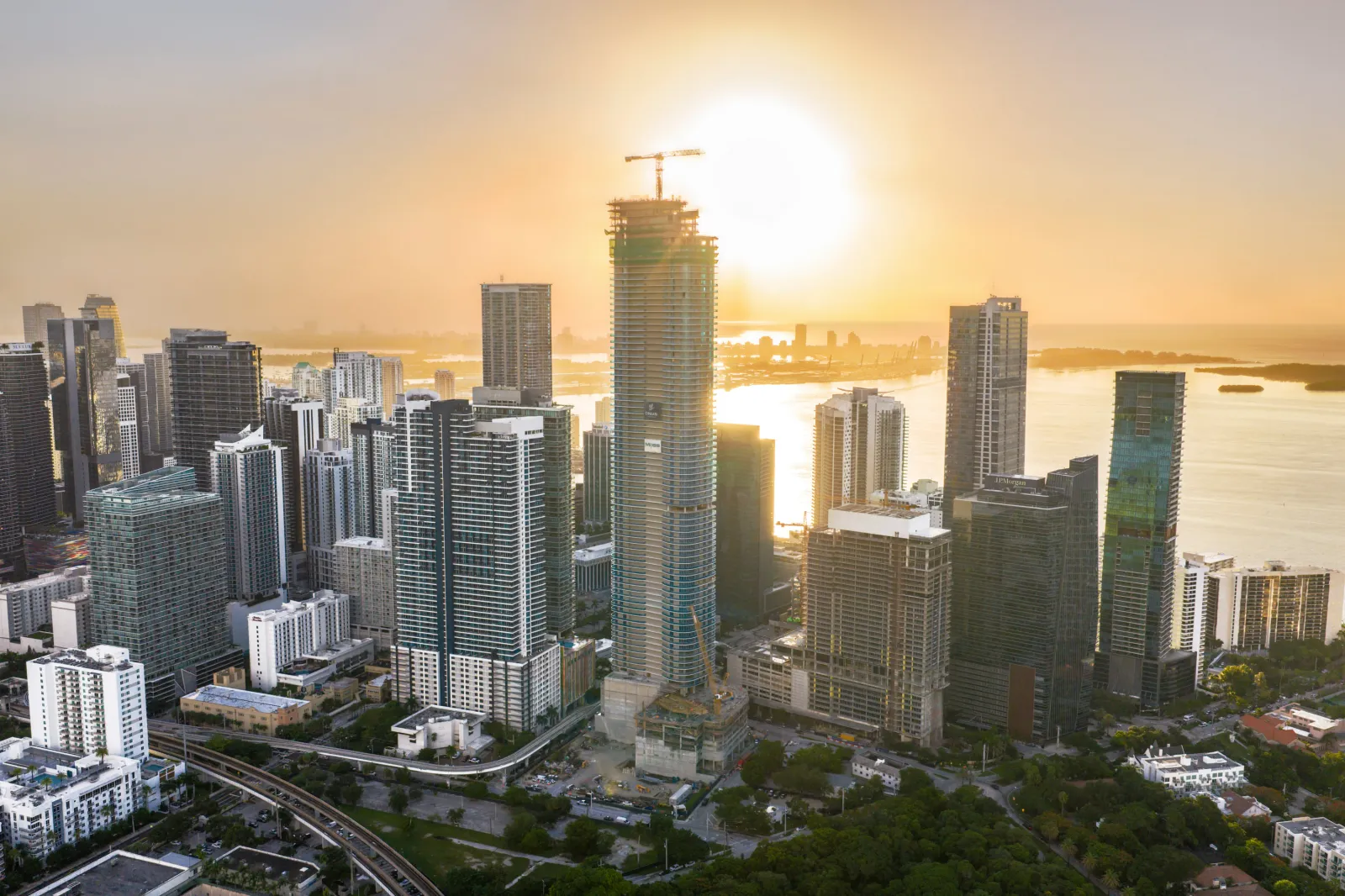
Cipriani Residences just topped out at 950 feet — Miami's new tallest. But it won't hold the title for long. The Waldorf Astoria will surpass it this fall at 1,049 feet, making Miami home to its first supertall. Here's what's driving the most dramatic skyline transformation in the city's history.
By Condo Invest Miami Research · Editorial & market research · 6 min read
The Title Changes Fast in Miami Right Now
For a few weeks this summer, Cipriani Residences held the title of Miami's tallest building. At 950 feet, the three-tower complex rising in Brickell is a genuinely impressive structure — wraparound terraces, floor-to-ceiling glass, the feel of the Italian Riviera transplanted to Biscayne Bay. But in Miami in 2026, even a record does not last long.
This fall, the Waldorf Astoria Hotel & Residences will surpass it. Designed as a stack of nine offset glass cubes, the Waldorf will reach 1,049 feet — the maximum height the Federal Aviation Administration permits in this airspace — making it Miami's first-ever supertall skyscraper. And it won't be the last. The Dolce & Gabbana tower, a matte black and ivory monolith capped with gold, is coming. So is Delano Residences, which will feature the first cantilevered observation deck in the Southeastern United States. In Sunny Isles Beach, Bentley Motors is building the tallest oceanfront building in the country — complete with a car elevator so residents can park their vehicles on their own floor.
Miami's skyline is being rewritten in real time, and the pace of change is unlike anything the city has experienced before.
Why Now? The FAA Rule That Started Everything
The current boom traces back to a regulatory decision made roughly a decade ago, when the FAA began approving Miami projects at the new maximum allowable height of 1,049 feet. That single change unlocked a race to the top that developers had been waiting years to run.
But the height approvals alone do not explain the scale of what is happening. The deeper driver is capital — and a lot of it has been moving south.
In the years following COVID-19, Florida became the destination of choice for the ultrawealthy. Ken Griffin relocated Citadel from Chicago in 2022. Howard Schultz, Peter Thiel, Mark Zuckerberg, and Larry Page have all reportedly deepened their ties to Miami. The city's former mayor courted crypto firms and took his salary in Bitcoin. Wall Street firms followed their clients south, and Miami earned the nickname "Wall Street South" for its fast-growing cluster of hedge funds and private equity shops.
Florida quadrupled its number of millionaires between 2010 and 2022. New York's millionaire count grew too, but its share relative to other states collapsed. The money did not disappear — it moved.
The Buildings That Are Reshaping the Skyline
Building · Height · Status · Developer
--- · --- · --- · ---
Cipriani Residences Miami · 950 ft · Topped out July 2026 · Arquitectonica / Cipriani
Okan Tower · 902 ft · Completing 2026 · Okan Group
Waldorf Astoria Hotel & Residences · 1,049 ft · Topping out Fall 2026 · PMG / Greybrook
888 Brickell by Dolce & Gabbana · ~1,049 ft · Under development · JDS Development
Delano Residences Miami · 985 ft · Breaking ground soon · PMG
Citadel HQ (Ken Griffin) · 54 stories · Under construction · Related / Citadel
Bentley Residences (Sunny Isles) · Tallest oceanfront in US · Under construction · Dezer Development
What unites most of these projects is the branded residence model — a format that has found its ideal market in Miami. Fashion houses, hospitality groups, and automobile manufacturers are all competing to attach their names to luxury towers. The logic is straightforward: a buyer purchasing a $15 million penthouse is also buying a brand identity, a community, and a level of service that a generic tower cannot offer.
Ryan Shear, managing partner of PMG — the firm behind both the Waldorf and Delano projects — described the environment bluntly: "Miami has been incredibly kind to developers. It's a wild west down here, but I love it, I prefer it this way."
What Makes a Miami Tower Different
The architects building these towers are quick to distinguish them from their New York counterparts. Bernardo Fort Brescia, founding principal of Arquitectonica — the firm behind Cipriani Residences and Brickell City Centre — put it simply: "What makes a Miami building different from a New York building? Let's begin with the most fundamental thing: We like terraces here. The building aesthetic is not a glass box, it's a layering of balconies of terraces."
The wraparound terrace has become Miami's architectural signature at altitude. Penthouses in these towers can have private pools, gardens, and outdoor kitchens. The amenity programs read less like a condo building and more like a vertical resort — fitness centers, spas, private clubs, wine cellars, and curated food and beverage concepts. The buildings function, as Fort Brescia noted, as "vertical country clubs."
Miami also benefits from a mixed-use zoning philosophy that most American cities have abandoned. Brickell is not a business district that empties out after 5 p.m. It is a neighborhood where people live, work, eat, and stay out late — a quality Fort Brescia traces back to a deliberate decision made by Miami's mayor in the 1970s to build a complete city rather than a segregated one.
The Risks That Come With the Boom
Not everyone is celebrating. UBS ranked Miami as the top city globally at risk of a real estate bubble in its most recent report — a designation that reflects the gap between current prices and underlying economic fundamentals. For the first time, Miami has become the second-most expensive metropolitan area in the United States, trailing only San Francisco. Prices that were once positioned as a discount to New York no longer are.
There are physical risks too. A 2024 University of Miami study found that dozens of oceanfront buildings — including major branded luxury condos and hotels — are sinking by as much as three inches. Sea levels are rising. Hurricanes are predicted to grow stronger and spin up faster. South Florida has strict building codes, but as architecture professor Jean-Francois Lejeune of the University of Miami noted, none of the new towers have been tested by a major storm. The last direct hurricane hit on Miami-Dade County was Andrew in 1992.
Lejeune has been vocal about his concerns regarding the direction of the boom. "There is quite a lot of space available in Miami, without concentrating all the investments in a series of super high buildings, which are literally taking over the skyline," he said. "They're an expression of private wealth. Transforming the landscape into an expression of CEO power is not what I was hoping to see develop in the city."
His critique extends to the tax question. Miami has attracted the ultrawealthy in part by offering them a low-tax environment — but the city is not capturing much revenue from the boom. "We want to attract these types of people, and we're not even going to make money out of them?" he asked. "That's really strange to me."
What This Means for Investors
For buyers and investors, the current moment in Miami presents a genuine tension. On one side: a city with strong fundamentals — low vacancy rates, robust rental demand, a growing corporate tenant base, and a pipeline of branded product that continues to attract global capital. On the other: a market that UBS has flagged as bubble-risk, where prices have risen faster than incomes and where the long-term structural risks — climate, infrastructure, taxation — remain unresolved.
The branded residence model offers one form of protection. Buildings with strong brand affiliations tend to hold value better in downturns because they attract a buyer who is less sensitive to price and more sensitive to exclusivity. The Cipriani name, the Waldorf name, the Dolce & Gabbana name — these carry weight in the international buyer pool that Miami increasingly depends on.
The more speculative end of the market — generic glass towers with no brand differentiation — is where the bubble risk is most concentrated. As Shear said, there are "a lot of people with ambition and money and capability that want to put up a lot of real estate." Not all of it will be worth what it costs to build.
Miami's skyline will look dramatically different by 2030. Whether the city's infrastructure, tax base, and climate resilience can keep pace with its ambition is the question that will define the decade.
Frequently Asked Questions
What is Miami's tallest building in 2026?
As of July 2026, Cipriani Residences Miami holds the title at 950 feet, having topped out this month. It will be surpassed in the fall of 2026 when the Waldorf Astoria Hotel & Residences reaches its final height of 1,049 feet — making it Miami's first supertall skyscraper.
What is a supertall skyscraper?
A supertall is defined as a skyscraper exceeding 984 feet (300 meters) in height. The Waldorf Astoria Miami, at 1,049 feet, will be Miami's first supertall when it tops out in fall 2026. The 1,049-foot height is also the maximum the FAA permits in Miami's airspace.
Is Miami real estate in a bubble in 2026?
UBS ranked Miami as the top city globally at risk of a real estate bubble in its most recent Global Real Estate Bubble Index. Miami has also become the second-most expensive metropolitan area in the US for the first time, trailing only San Francisco. While demand from international and domestic buyers remains strong, the gap between prices and local incomes is a concern flagged by analysts.
What branded residences are being built in Miami?
Several major branded residence projects are under development in Miami: 888 Brickell by Dolce & Gabbana (matte black and ivory tower with gold cap), Waldorf Astoria Hotel & Residences (1,049 feet, nine offset cubes), Cipriani Residences (950 feet, three towers), Delano Residences (985 feet, first cantilevered observation deck in the Southeast), and Bentley Residences in Sunny Isles Beach (tallest oceanfront building in the US, with a car elevator).
Why are so many billionaires moving to Miami?
Florida's zero state income tax, business-friendly regulatory environment, and low cost of doing business relative to New York and California have attracted significant wealth migration. Ken Griffin (Citadel), Howard Schultz, Peter Thiel, Mark Zuckerberg, and Larry Page have all reportedly deepened their ties to Miami. Florida quadrupled its number of millionaires between 2010 and 2022.